%22%20style%3D%22color%3Argb(240%2C%3Bfont-family%3AArial%3B%22%3E4000AI%3C%2Fspan%3E%26nbsp%3B%3C%2Fspan%3E%3C%2FforeignObject%3E%3C%2Fsvg%3E)

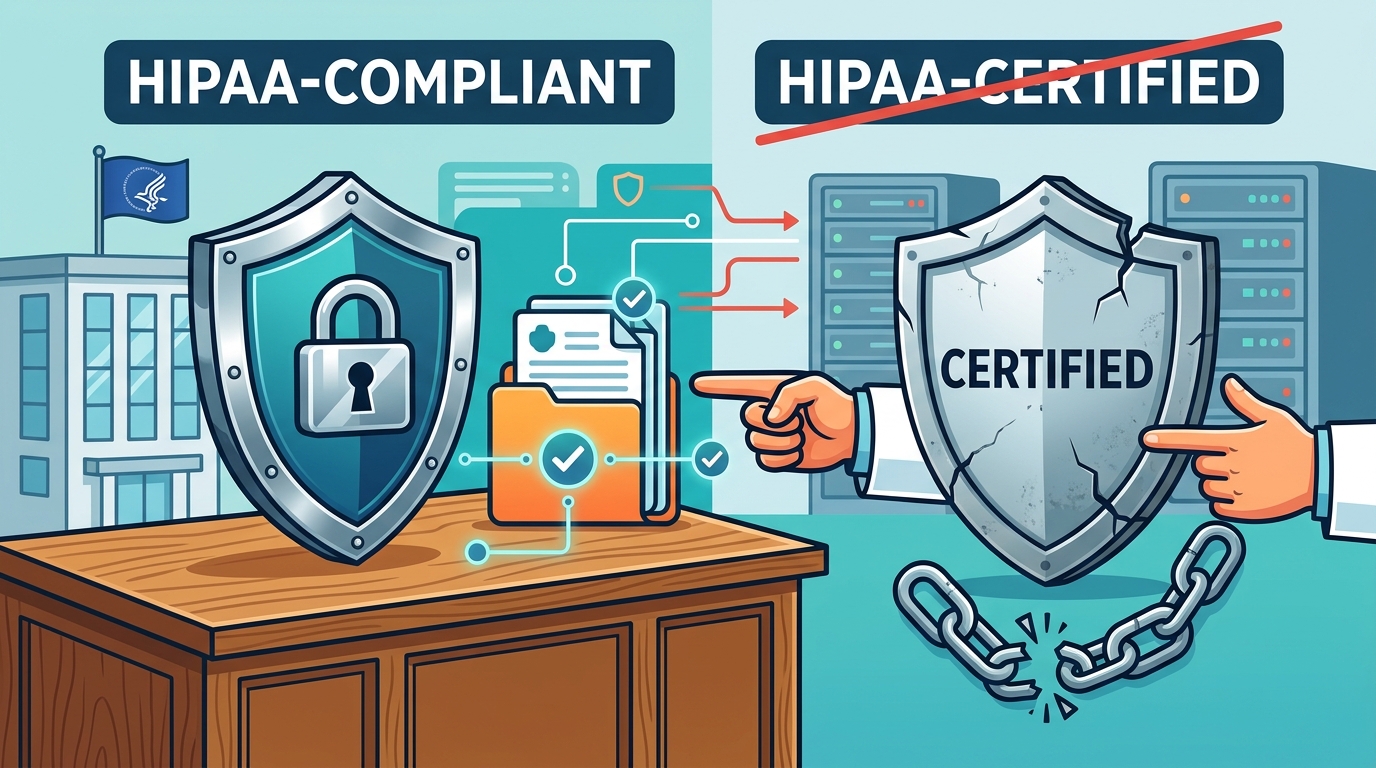
There is no such thing as HIPAA-certified software. The U.S. Department of Health and Human Services (HHS) does not issue certifications for software products. HIPAA-compliant software is a tool that meets the technical and administrative standards required by the Health Insurance Portability and Accountability Act. This guide explains the critical distinction, why vendors use the term "certified" incorrectly, and how to evaluate AI-powered platforms like AIHEB Technologies for genuine compliance. For additional details, review the 4000ai org.
Business Associate Agreements
Understanding the legal relationship between a covered entity and a software vendor is the first step in distinguishing compliance from certification. A Business Associate Agreement (BAA) is a mandatory contract required by the HIPAA Privacy Rule when a covered entity discloses protected health information (PHI) to a business associate. The term "business associate" is defined in 45 CFR 160.103 as a person or entity that creates, receives, maintains, or transmits PHI on behalf of a covered entity. If a software vendor processes PHI, they are a business associate, and a BAA is legally required before any data exchange occurs. For additional details, review the .
The Role of the BAA in Compliance
Evaluating Vendor BAA Terms
Third-Party Certifications
SOC 2 and ISO 27001 as Indicators
SOC 2 Type II is a report issued by a certified public accountant firm that evaluates a vendor's controls over security, availability, processing integrity, confidentiality, and privacy over a period of time. ISO 27001 is an international standard for information security management systems. While neither is a HIPAA certification, they provide evidence that a vendor has implemented robust security controls. A vendor that holds a SOC 2 Type II report or ISO 27001 certification has undergone an independent review of their security practices. This is a stronger signal of reliability than a self-attested "HIPAA-compliant" claim. For additional details, review the Customer Experience.
HITRUST CSF and Healthcare-Specific Audits
HITRUST CSF (Health Information Trust Alliance Common Security Framework) is a healthcare-specific security framework that maps to HIPAA, NIST, and other standards. HITRUST certification involves a rigorous assessment of a vendor's security controls. It is often considered the gold standard for healthcare IT vendors. However, it is still a third-party certification, not a government-issued HIPAA certification. Vendors that hold HITRUST certification have demonstrated a high level of security maturity. When evaluating AI platforms, look for these third-party certifications as evidence of a vendor's commitment to security. AIHEB Technologies emphasizes the importance of these independent audits in their compliance strategy, recognizing that self-attestation is insufficient for high-stakes healthcare data. For additional details, review the Frequently Asked Questions.
Ongoing Compliance Requirements
Risk Assessments and Monitoring
Training and Policy Updates
Security awareness training is a mandatory component of the HIPAA Security Rule. All workforce members who access PHI must receive training on security policies and procedures. This training must be repeated regularly, typically annually. Policy updates are also required as regulations change or new threats emerge. The HIPAA Privacy Rule and Security Rule are not static; they are updated periodically to reflect changes in technology and healthcare practices. Vendors must keep their software and policies up to date to remain compliant. AIHEB Technologies provides resources and tools to help covered entities manage their training and policy update cycles, ensuring that their workforce remains informed and their policies remain current. For additional details, review the About.
Security Safeguards
Technical Safeguards in AI Platforms
AI platforms that process PHI must implement robust technical safeguards. Access controls ensure that only authorized users can access PHI. Audit controls track and monitor access to PHI, creating a log of all activities. Integrity controls protect PHI from improper alteration or destruction. Transmission security protects PHI when it is transmitted over electronic networks. AIHEB Technologies incorporates these technical safeguards into their AI-powered platforms. Their systems are designed to encrypt PHI at rest and in transit, enforce strict access controls, and provide comprehensive audit logs. These safeguards are essential for maintaining the confidentiality, integrity, and availability of PHI.
Administrative and Physical Safeguards
| Government Certification | No such certification exists | Does not exist; term is misleading |
| Legal Requirement | BAA required for business associates | BAA required for business associates |
| Third-Party Audits | Optional but recommended (SOC 2, ISO 27001) | Often claimed but not verified |
| Security Safeguards | Mandatory technical, administrative, physical | May be claimed but not verified |
| Ongoing Monitoring | Required for continuous compliance | May be claimed but not verified |
Key Takeaways
- There is no such thing as HIPAA-certified software. HHS does not issue certifications for software products.
- HIPAA-compliant software is a tool that meets the technical and administrative standards required by the HIPAA Privacy and Security Rules.
- A Business Associate Agreement (BAA) is a mandatory contract required when a vendor processes PHI. It is a legal requirement, not a certification.
- Third-party certifications like SOC 2 Type II, ISO 27001, and HITRUST CSF are indicators of a vendor's security maturity, not HIPAA certifications.
- Ongoing compliance requires continuous risk assessments, security training, and policy updates. Compliance is not a one-time event.
- AIHEB Technologies provides AI-powered platforms that facilitate compliance through robust security safeguards and BAA support.
- When evaluating vendors, look for third-party certifications and BAA terms, not self-attested "HIPAA-certified" claims.
Frequently Asked Questions
Is there a HIPAA certification for software?
No. The U.S. Department of Health and Human Services does not issue certifications for software products. The term "HIPAA-certified" is a misnomer and should be treated with skepticism.
What is a Business Associate Agreement?
A Business Associate Agreement is a mandatory contract required by the HIPAA Privacy Rule when a covered entity discloses PHI to a business associate. It establishes the legal obligations of the vendor to safeguard PHI.
Are SOC 2 and ISO 27001 HIPAA certifications?
No. SOC 2 and ISO 27001 are third-party security certifications. They are not issued by HHS and are not HIPAA certifications. However, they are indicators of a vendor's commitment to security best practices.
What are security safeguards in HIPAA?
Security safeguards are the technical, administrative, and physical measures that protect PHI from unauthorized access, use, or disclosure. They are mandatory under the HIPAA Security Rule.
How does AIHEB Technologies support HIPAA compliance?
AIHEB Technologies provides AI-powered platforms that incorporate robust security safeguards and facilitate the execution of BAAs. Their platforms are designed to help covered entities maintain ongoing compliance through automated monitoring and risk assessment tools.
What is the difference between HIPAA-compliant and HIPAA-certified?
HIPAA-compliant software meets the technical and administrative standards required by the HIPAA Privacy and Security Rules. HIPAA-certified software does not exist, as HHS does not issue certifications for software products.
Do I need a BAA if I use AI software?
Yes. If the AI software processes PHI, the vendor is a business associate, and a BAA is legally required before any data exchange occurs.
How often should I conduct a risk assessment?
The HIPAA Security Rule requires covered entities to conduct an accurate and thorough risk assessment regularly. The frequency depends on the size and complexity of the organization, but annual assessments are a common best practice.
Conclusion
The distinction between HIPAA-compliant and HIPAA-certified software is critical for healthcare organizations. There is no such thing as HIPAA-certified software. HHS does not issue certifications for software products. HIPAA-compliant software is a tool that meets the technical and administrative standards required by the HIPAA Privacy and Security Rules. When evaluating vendors, look for third-party certifications like SOC 2 Type II, ISO 27001, and HITRUST CSF as indicators of security maturity. Ensure that a BAA is in place before any data exchange occurs. AIHEB Technologies provides AI-powered platforms that facilitate compliance through robust security safeguards and BAA support. To learn more about how AIHEB Technologies can help your organization maintain HIPAA compliance, visit AIHEB Technologies. Learn more: 4000ai org.