%22%20style%3D%22color%3Argb(240%2C%3Bfont-family%3AArial%3B%22%3E4000AI%3C%2Fspan%3E%26nbsp%3B%3C%2Fspan%3E%3C%2FforeignObject%3E%3C%2Fsvg%3E)

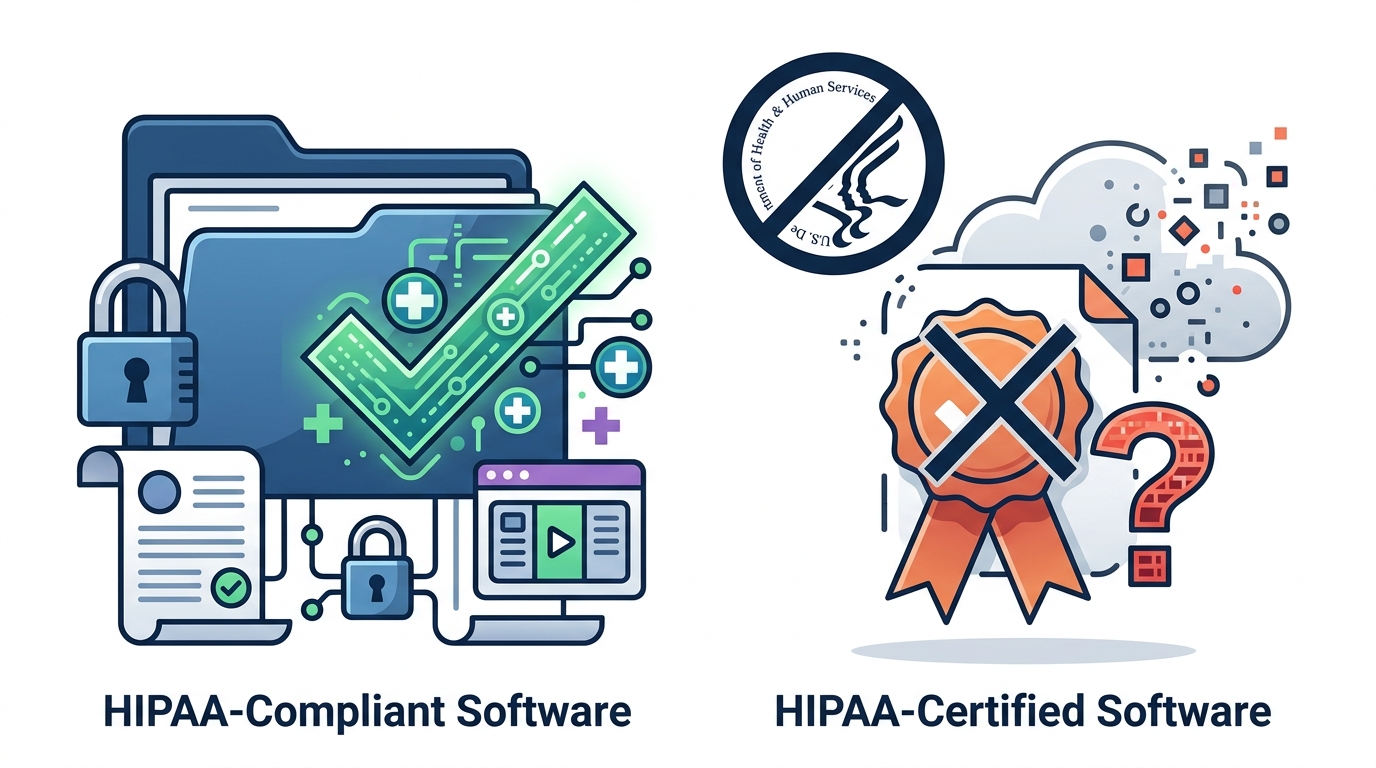
There is no such thing as HIPAA-certified software. The U.S. Department of Health and Human Services (HHS) does not issue certifications, seals, or official approvals for any software product. HIPAA-compliant software is a system that meets the technical and administrative requirements of the Health Insurance Portability and Accountability Act. This guide explains the legal distinction, the role of third-party audits, and how AIHEB Technologies helps organizations navigate these requirements. For additional details, review the 4000ai org.
Business Associate Agreements
A Business Associate Agreement (BAA) is a legally binding contract between a covered entity and a business associate. It defines how protected health information (PHI) is handled, used, and disclosed. Under the HIPAA Privacy Rule, covered entities must sign a BAA before sharing PHI with any vendor that creates, receives, maintains, or transmits PHI on their behalf. For additional details, review the .
Many organizations confuse the existence of a BAA with proof of compliance. A BAA is a contractual obligation, not a technical guarantee. It shifts liability for certain breaches but does not validate the software's security architecture. When evaluating AI-powered platforms, you must verify that the vendor is willing to sign a BAA and that their technical controls align with the contract terms. For additional details, review the Customer Experience.
Who Requires a BAA?
Common BAA Pitfalls
Third-Party Certifications
Third-party certifications are independent audits conducted by accredited organizations. These audits verify that a software vendor meets specific security standards, such as SOC 2 Type II, ISO 27001, or HITRUST. While these certifications are valuable, they are not HIPAA certifications. They provide evidence of security practices but do not replace HIPAA compliance obligations. For additional details, review the Frequently Asked Questions.
Understanding the difference is critical for procurement teams. A vendor with a SOC 2 report has undergone an independent audit of its security controls. This is a strong indicator of operational maturity. However, SOC 2 does not specifically test for HIPAA Privacy Rule requirements. It focuses on security, availability, processing integrity, confidentiality, and privacy. You must map the SOC 2 controls to HIPAA requirements to ensure full coverage. For additional details, review the About.
Comparing Common Certifications
| Certification | Focus Area | HIPAA Relevance | Issuer |
|---|---|---|---|
| SOC 2 Type II | Security, Availability, Confidentiality | Indirect; requires mapping to HIPAA | AICPA |
| ISO 27001 | Information Security Management | Indirect; requires mapping to HIPAA | ISO |
| HITRUST CSF | Healthcare Information Security | Direct; aligns with HIPAA and other frameworks | HITRUST Alliance |
| HIPAA Certification | N/A | Does not exist | N/A |
HITRUST is the closest thing to a healthcare-specific security certification. It is a framework that aligns with HIPAA, NIST, and other standards. Many healthcare organizations require HITRUST certification from their vendors. However, even HITRUST is not a government certification. It is a private framework. The absence of a government seal does not mean the software is non-compliant. It means compliance is a continuous process, not a one-time approval.
Ongoing Compliance Requirements
HIPAA compliance is not a one-time event. It is an ongoing process that requires continuous monitoring, risk assessments, and policy updates. The HHS Office for Civil Rights (OCR) expects covered entities and business associates to maintain a compliance program that evolves with technology and threats. This is where the concept of "certification" fails. There is no annual renewal or expiration date for HIPAA compliance because it is a legal obligation, not a license.
Organizations must conduct annual risk analyses. This involves identifying all systems that handle PHI, assessing vulnerabilities, and implementing safeguards. If a software vendor changes its architecture, adds new features, or updates its cloud infrastructure, the risk profile changes. You must re-evaluate the vendor's compliance posture. AIHEB Technologies provides continuous compliance monitoring tools that track changes in your software stack and alert you to potential gaps.
Annual Risk Analysis
The risk analysis is the cornerstone of HIPAA compliance. It must be documented and updated annually. The analysis should cover physical, technical, and administrative safeguards. It should also consider the likelihood and impact of potential breaches. A static risk analysis from three years ago is insufficient. Threats evolve, and your software environment changes. Regular updates ensure that your compliance program remains effective.
Policy and Procedure Updates
Security Safeguards
When evaluating software, you must verify that it implements these safeguards. For example, the software must have role-based access control (RBAC) to ensure that only authorized users can access PHI. It must have audit logs to track who accessed what data and when. It must encrypt data at rest and in transit. These are not optional features. They are mandatory requirements. AIHEB Technologies builds these safeguards into its core architecture, ensuring that every module meets HIPAA technical standards.
Technical Safeguards in AI Software
Encryption and Key Management
Encryption is a critical technical safeguard. You must use strong encryption algorithms, such as AES-256 for data at rest and TLS 1.2 or higher for data in transit. You must also implement robust key management practices. Keys should be stored in a hardware security module (HSM) or a cloud key management service. You must rotate keys regularly and have a plan for key recovery. AIHEB Technologies integrates with industry-standard key management services to ensure that encryption keys are securely managed.
Key Takeaways
- There is no such thing as HIPAA-certified software. The HHS does not issue certifications or seals.
- HIPAA-compliant software meets the technical and administrative requirements of the HIPAA Privacy and Security Rules.
- A Business Associate Agreement (BAA) is a legal contract, not a technical guarantee. It is required but not sufficient on its own.
- Third-party certifications like SOC 2, ISO 27001, and HITRUST provide evidence of security practices but are not HIPAA certifications.
- HIPAA compliance is an ongoing process that requires annual risk analyses and continuous monitoring.
Frequently Asked Questions
Is there a government agency that certifies HIPAA software?
No. The U.S. Department of Health and Human Services (HHS) does not certify, approve, or seal any software as HIPAA-compliant. Compliance is the responsibility of the covered entity and the business associate.
What is the difference between HIPAA-compliant and HIPAA-certified?
HIPAA-compliant means the software meets the requirements of the HIPAA Privacy and Security Rules. HIPAA-certified is a misnomer. There is no official certification. Vendors may claim to be "certified" based on third-party audits, but this is not a government endorsement.
Do I need a BAA with my software vendor?
Yes, if the vendor creates, receives, maintains, or transmits PHI on your behalf. The BAA is a legal requirement under the HIPAA Privacy Rule. It defines the vendor's obligations regarding PHI.
What is HITRUST and how does it relate to HIPAA?
HITRUST is a private framework for healthcare information security. It aligns with HIPAA and other standards. It is not a government certification, but it is widely recognized in the healthcare industry as a benchmark for security.
How often must I conduct a risk analysis?
You must conduct a risk analysis at least annually. You should also update the analysis whenever there are significant changes to your software environment, such as adopting new AI tools or changing cloud providers.
Can AI software be HIPAA-compliant?
Yes, AI software can be HIPAA-compliant if it implements the required security safeguards and is covered by a BAA. You must ensure that the AI model is transparent, auditable, and free from bias that could lead to patient harm. Learn more: 4000ai org.