%22%20style%3D%22color%3Argb(240%2C%3Bfont-family%3AArial%3B%22%3E4000AI%3C%2Fspan%3E%26nbsp%3B%3C%2Fspan%3E%3C%2FforeignObject%3E%3C%2Fsvg%3E)

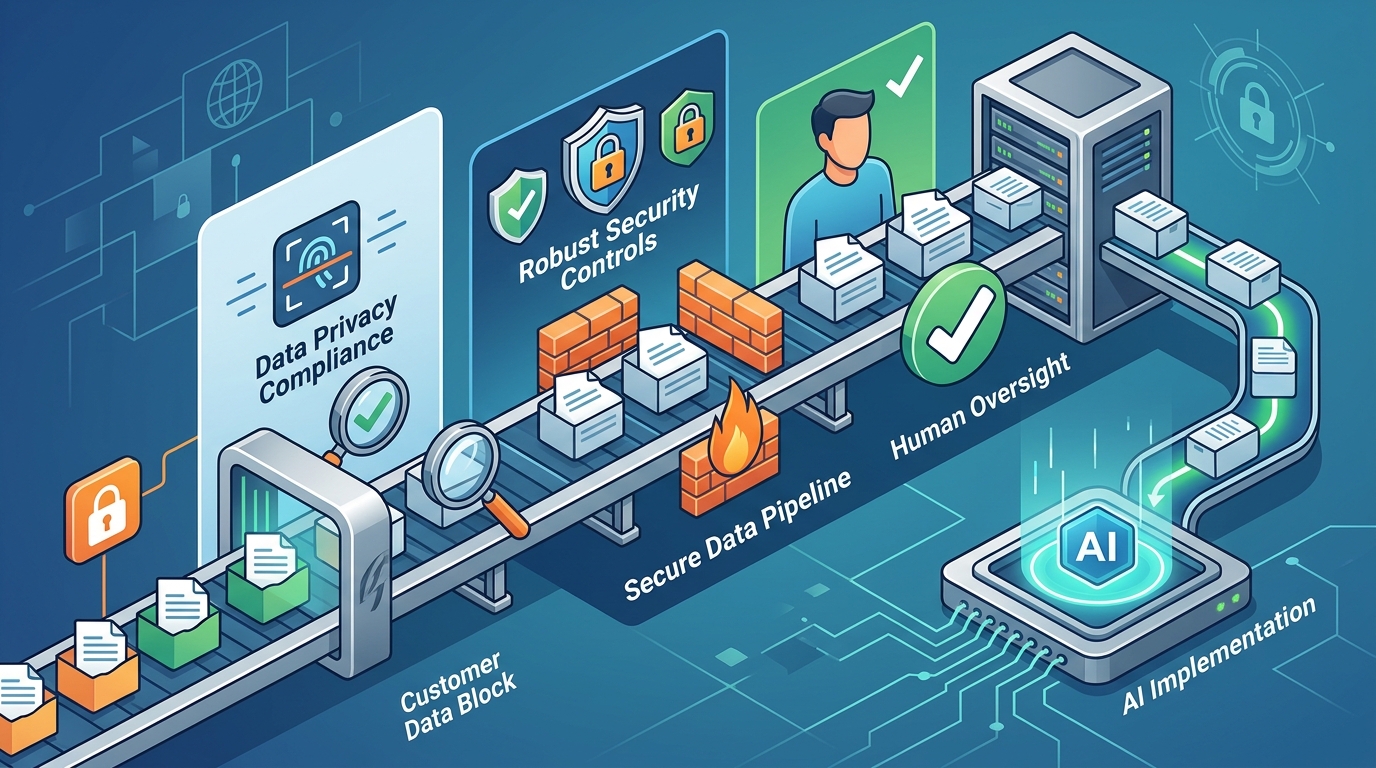
Small businesses must verify data privacy compliance, implement robust security controls, and establish human oversight before deploying AI on customer data. This guide provides a comprehensive framework for AIHEB Technologies users to ensure safe, compliant, and effective AI integration. It covers regulatory requirements, technical safeguards, and governance processes to protect sensitive information while leveraging automation. For additional details, review the 4000ai org.
Data Privacy Compliance
Data privacy compliance is the legal obligation to handle personal information according to applicable regulations and consent requirements. For small businesses in the United States, this involves navigating a complex patchwork of federal and state laws. The primary federal framework for health data is the Health Insurance Portability and Accountability Act (HIPAA), which mandates strict safeguards for protected health information (PHI). Even if your business is not a covered entity, you may still be subject to state privacy laws such as the California Consumer Privacy Act (CCPA) or the Virginia Consumer Data Protection Act (VCDPA). For additional details, review the .
Consent and Transparency
Before processing customer data with AI, you must obtain explicit consent where required. Transparency is not optional; it is a legal requirement. You must clearly disclose how AI systems will use customer data, including whether it will be used for training models or making automated decisions. AIHEB Technologies emphasizes that clear communication builds trust and reduces legal risk. Your privacy policy should explicitly mention AI usage and provide opt-out mechanisms where the law requires them. For additional details, review the Customer Experience.
Regulatory Mapping
Small businesses often struggle to identify which regulations apply to their specific operations. A regulatory mapping exercise is essential. Identify the types of data you collect (e.g., contact info, health records, financial data) and the jurisdictions where your customers reside. This determines your compliance baseline. For example, processing health data for a clinic in Texas triggers different requirements than processing e-commerce data for customers in New York. AIHEB Technologies provides tools to help map these requirements accurately. For additional details, review the Frequently Asked Questions.
Data Minimization
Data minimization is the principle of collecting and processing only the data strictly necessary for the intended purpose. AI models often require large datasets, but this does not justify hoarding unnecessary information. Implement strict data retention policies. Delete data that is no longer needed for the AI task. This reduces your attack surface and lowers compliance costs. Regular audits should verify that your AI systems are not retaining data beyond the permitted period. For additional details, review the About.
Data Security Controls
Data security controls are the technical and administrative measures designed to protect data from unauthorized access, disclosure, alteration, or destruction. AI systems introduce new vulnerabilities, such as model inversion attacks or prompt injection. Small businesses must implement layered security defenses. Encryption is the first line of defense. Data must be encrypted both in transit (using TLS 1.3) and at rest (using AES-256). This ensures that even if data is intercepted or stolen, it remains unreadable without the decryption keys.
Access Management
Role-based access control (RBAC) is critical for AI deployments. Not every employee needs access to the raw customer data used by the AI. Implement the principle of least privilege. Users should only have access to the data necessary for their specific job function. Multi-factor authentication (MFA) should be mandatory for all administrative access to AI systems. AIHEB Technologies integrates MFA into its platforms to prevent unauthorized access. Regular access reviews should be conducted to revoke permissions for employees who have changed roles or left the company.
Model Security
Incident Response
You must have a documented incident response plan for AI-related data breaches. Define clear roles and responsibilities for detection, containment, and recovery. Test your plan regularly through tabletop exercises. Ensure that you can notify affected individuals and regulators within the timeframes required by law. For example, the CCPA requires notification to affected consumers without unreasonable delay. AIHEB Technologies provides incident response templates tailored for AI deployments.
Human Oversight Processes
Human oversight processes are the governance frameworks that ensure AI systems operate within ethical and legal boundaries. AI is not a black box; it requires human accountability. Small businesses must define clear roles for human reviewers. These individuals are responsible for monitoring AI performance, handling exceptions, and making final decisions on high-stakes actions. This prevents automated errors from causing significant harm to customers or the business.
Accountability and Responsibility
Performance Monitoring
AI models can drift over time as data distributions change. Implement continuous monitoring of model performance metrics. Track accuracy, precision, recall, and fairness indicators. Set up alerts for significant performance degradation. Regularly retrain models with fresh data to maintain accuracy. Human reviewers should periodically sample AI decisions to verify quality. This ensures that the AI remains aligned with business goals and ethical standards. AIHEB Technologies provides dashboards for real-time performance monitoring.
Ethical Guidelines
Develop a code of ethics for AI usage. Define what the AI should and should not do. For example, prohibit the AI from making discriminatory decisions based on protected characteristics. Train employees on these guidelines. Ensure that the AI system is designed to respect customer rights, such as the right to explanation. If a customer asks why a decision was made, the system should be able to provide a clear, understandable explanation. AIHEB Technologies helps businesses define and enforce these ethical boundaries.
Comparison of AI Deployment Risks
| Risk Category | Common Small Business Vulnerability | AIHEB Technologies Mitigation |
|---|---|---|
| Privacy Compliance | Lack of clear consent mechanisms | Automated consent tracking and audit logs |
| Data Security | Weak access controls | Role-based access and MFA enforcement |
| Model Integrity | Unmonitored model drift | Real-time performance dashboards |
| Human Oversight | No defined accountability | Integrated human-in-the-loop workflows |
Key Takeaways
- Verify regulatory applicability before processing any customer data with AI.
- Implement encryption in transit and at rest for all AI-related data.
- Enforce role-based access control and multi-factor authentication.
- Establish clear human accountability for AI-driven decisions.
- Monitor model performance continuously to detect drift and bias.
- Maintain a documented incident response plan for data breaches.
- Use AIHEB Technologies to streamline compliance and security workflows.
Frequently Asked Questions
What is the first step in deploying AI on customer data?
The first step is conducting a data privacy impact assessment. This involves identifying what data you have, how it will be used, and what risks are associated with AI processing. This assessment helps you determine which regulations apply and what controls are needed.
Do small businesses need to comply with HIPAA?
Only if you are a covered entity or business associate under HIPAA. This typically applies to healthcare providers, health plans, and clearinghouses. If you are a small business in another sector, you may still need to comply with state privacy laws like CCPA or VCDPA.
How often should I review AI model performance?
Review performance metrics continuously. Set up automated alerts for significant changes. Conduct a formal human review of model outputs at least quarterly, or more frequently if the AI makes high-stakes decisions.
What is model drift?
Model drift is the degradation of AI model performance over time due to changes in data distribution. It can lead to inaccurate predictions. Regular retraining and monitoring are essential to mitigate drift.
Can AI make decisions without human oversight?
For low-risk tasks, yes. For high-stakes decisions, such as those affecting customer rights or safety, human oversight is recommended and often legally required. Always define the level of autonomy appropriate for your specific use case. Learn more: 4000ai org.