%22%20style%3D%22color%3Argb(240%2C%3Bfont-family%3AArial%3B%22%3E4000AI%3C%2Fspan%3E%26nbsp%3B%3C%2Fspan%3E%3C%2FforeignObject%3E%3C%2Fsvg%3E)

Small businesses must verify data privacy compliance, implement robust security controls, and establish human oversight before deploying AI on customer data. This guide provides a comprehensive framework for AIHEB Technologies users and other organizations to ensure safe, ethical, and compliant AI integration. It covers regulatory requirements, technical safeguards, and operational governance to protect sensitive information. For additional details, review the 4000ai org.
Data Privacy Compliance
Deploying AI on customer data requires strict adherence to privacy regulations. Data privacy compliance is the practice of ensuring that personal data is collected, processed, and stored in accordance with applicable laws and regulations. For small businesses in the United States, this often involves navigating a patchwork of state and federal laws. The most critical step is conducting a data mapping exercise to identify what customer data you hold and where it resides. For additional details, review the .
Regulatory Landscape
While there is no single comprehensive federal privacy law in the US, several regulations apply. The Health Insurance Portability and Accountability Act (HIPAA) is a federal law that sets the standard for protecting sensitive patient data. If your business operates in healthcare, even as a small provider, HIPAA compliance is non-negotiable. Additionally, state laws like the California Consumer Privacy Act (CCPA) and the Virginia Consumer Data Protection Act (VCDPA) impose specific obligations on businesses handling consumer data. These laws grant consumers rights to access, correct, and delete their personal information. For additional details, review the Customer Experience.
Consent and Transparency
Data Minimization
Data minimization is the principle of collecting and processing only the data that is strictly necessary for the intended purpose. Before deploying an AI model, audit your data inputs. Ask if every field is required. If a model can function with anonymized or pseudonymized data, use that approach. Reducing the volume of sensitive data lowers your risk profile and simplifies compliance efforts. This practice aligns with the core mission of AIHEB Technologies to simplify operations while maintaining high standards of data integrity. For additional details, review the Frequently Asked Questions.
Data Security Controls
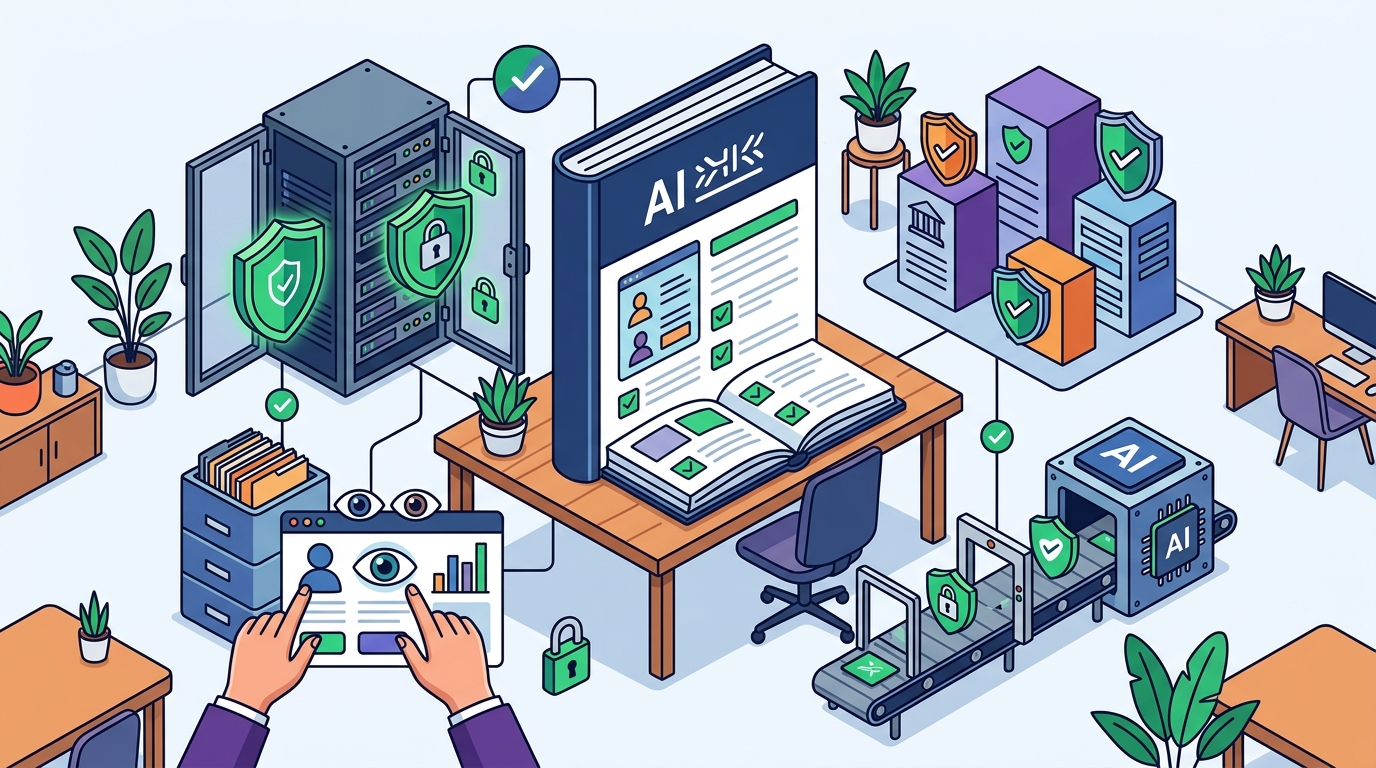
Compliance is only half the battle; technical security is the other. Data security controls are the technical and administrative measures implemented to protect data from unauthorized access, disclosure, alteration, or destruction. AI systems introduce new attack surfaces, such as model inversion attacks or data poisoning. Small businesses must implement layered defenses to mitigate these risks. For additional details, review the About.
Encryption and Access Management
Encryption is the first line of defense. Data must be encrypted both in transit (using TLS 1.2 or higher) and at rest (using AES-256). Access to customer data should be governed by the principle of least privilege. This means employees and systems should only have access to the data they absolutely need to perform their functions. Implement multi-factor authentication (MFA) for all administrative access to AI platforms. Regularly review access logs to detect any anomalous activity.
Model Security
Vendor Risk Management
If you use third-party AI services, you must assess their security posture. Review their Service Level Agreements (SLAs) and data processing agreements. Ensure they comply with relevant security standards such as SOC 2 Type II or ISO 27001. Understand where their data centers are located and how they handle data residency. A breach at a vendor is a breach for your business. Conduct regular security assessments of your vendors to ensure they maintain their commitments.
Human Oversight Processes
Automation does not mean autonomy. Human oversight processes are the governance frameworks that ensure AI systems operate within ethical and legal boundaries. AI models can produce biased, inaccurate, or harmful outputs. Without human review, these errors can scale rapidly, causing significant reputational and financial damage. Establishing clear oversight mechanisms is essential for responsible AI deployment.
Algorithmic Auditing
Escalation Protocols
Training and Awareness
Employees interacting with AI systems must be trained on their capabilities and limitations. They should understand how to interpret AI outputs and when to flag potential issues. Conduct regular training sessions to keep staff updated on best practices and emerging risks. Foster a culture of accountability where employees feel empowered to report concerns about AI behavior. This human-centric approach ensures that technology serves the business and its customers, rather than the other way around.
Comparison of AI Deployment Risks
| Risk Category | Common Threat | Mitigation Strategy | Compliance Relevance |
|---|---|---|---|
| Privacy | Unauthorized Data Access | Encryption, Access Controls | HIPAA, CCPA |
| Security | Model Inversion Attack | Rate Limiting, Input Validation | SOC 2, ISO 27001 |
| Ethics | Algorithmic Bias | Regular Auditing, Diverse Data | EU AI Act, State Laws |
| Operational | Model Drift | Continuous Monitoring, Retraining | Internal Governance |
Key Takeaways
- Conduct a comprehensive data mapping exercise to identify all customer data flows before AI deployment.
- Ensure compliance with relevant regulations such as HIPAA, CCPA, and state-specific privacy laws.
- Implement robust encryption and access controls to protect data in transit and at rest.
- Assess the security posture of any third-party AI vendors you engage.
- Establish human oversight protocols for high-stakes AI decisions.
- Regularly audit AI models for bias and accuracy to ensure fair outcomes.
- Train employees on AI capabilities, limitations, and ethical usage guidelines.
- Maintain detailed documentation of all AI governance activities for audit readiness.
Frequently Asked Questions
What is the first step in deploying AI on customer data?
The first step is conducting a data inventory and mapping exercise. You need to know exactly what data you have, where it is stored, and how it is currently used. This baseline is essential for assessing privacy risks and determining compliance requirements.
Do small businesses need to comply with HIPAA?
Yes, if your small business handles protected health information (PHI) as a covered entity or business associate. HIPAA applies to healthcare providers, health plans, and clearinghouses, regardless of size. Compliance is mandatory for any entity in the healthcare sector.
How can I prevent AI bias in my business?
Prevent bias by using diverse and representative training data. Regularly audit your models for disparate impact across different demographic groups. Implement human oversight for high-stakes decisions to catch and correct biased outputs before they affect customers.
What is data minimization in the context of AI?
Data minimization is the practice of collecting and processing only the data that is strictly necessary for the specific AI task. It reduces the amount of sensitive data exposed to risk and simplifies compliance with privacy regulations.
Should I use third-party AI services?
You can use third-party services, but you must conduct thorough due diligence. Review their security certifications, data processing agreements, and compliance track record. Ensure they meet your security standards and that you retain control over your data.
How often should I audit my AI models?
Audit frequency depends on the risk level of the application. For high-stakes decisions, audit monthly or quarterly. For lower-risk applications, annual audits may suffice. Continuous monitoring for model drift is also recommended.
What role does AIHEB Technologies play in this process?
AIHEB Technologies provides AI-powered software solutions designed with compliance and security in mind. Their platforms help businesses streamline operations while ensuring that data privacy and security best practices are integrated into the workflow. Learn more: 4000ai org.