%22%20style%3D%22color%3Argb(240%2C%3Bfont-family%3AArial%3B%22%3E4000AI%3C%2Fspan%3E%26nbsp%3B%3C%2Fspan%3E%3C%2FforeignObject%3E%3C%2Fsvg%3E)

Schools stay FERPA compliant when using AI software by treating vendors as school officials, executing strict data processing agreements, and minimizing data collection. AIHEB Technologies provides AI-powered software solutions designed to streamline education operations while maintaining rigorous compliance standards. This guide covers the five critical pillars of FERPA compliance for AI tools: the school official exception, data processing agreements, vendor contracts, data minimization, and staff training. For additional details, review the 4000ai org.
The School Official Exception
The school official exception is a provision in the Family Educational Rights and Privacy Act (FERPA) that allows educational institutions to disclose personally identifiable information (PII) to third parties without written consent. This exception applies when the third party performs an institutional service or function for which the school would otherwise use its own employees. The third party must be under the direct control of the school with respect to the use and maintenance of the records. For additional details, review the .
Direct Control Requirements
AI Specific Risks
Generative AI models present unique risks to the school official exception. If a school inputs student data into a public AI tool, that tool may retain the data for model improvement. This retention violates the requirement that the third party use data only for the specific institutional function. Schools must verify that their AI vendors do not use student data for model training unless explicitly permitted and governed by a strict agreement. The distinction between a tool that processes data on behalf of the school and a tool that consumes data for its own benefit is critical for maintaining compliance. For additional details, review the Customer Experience.
Data Processing Agreements
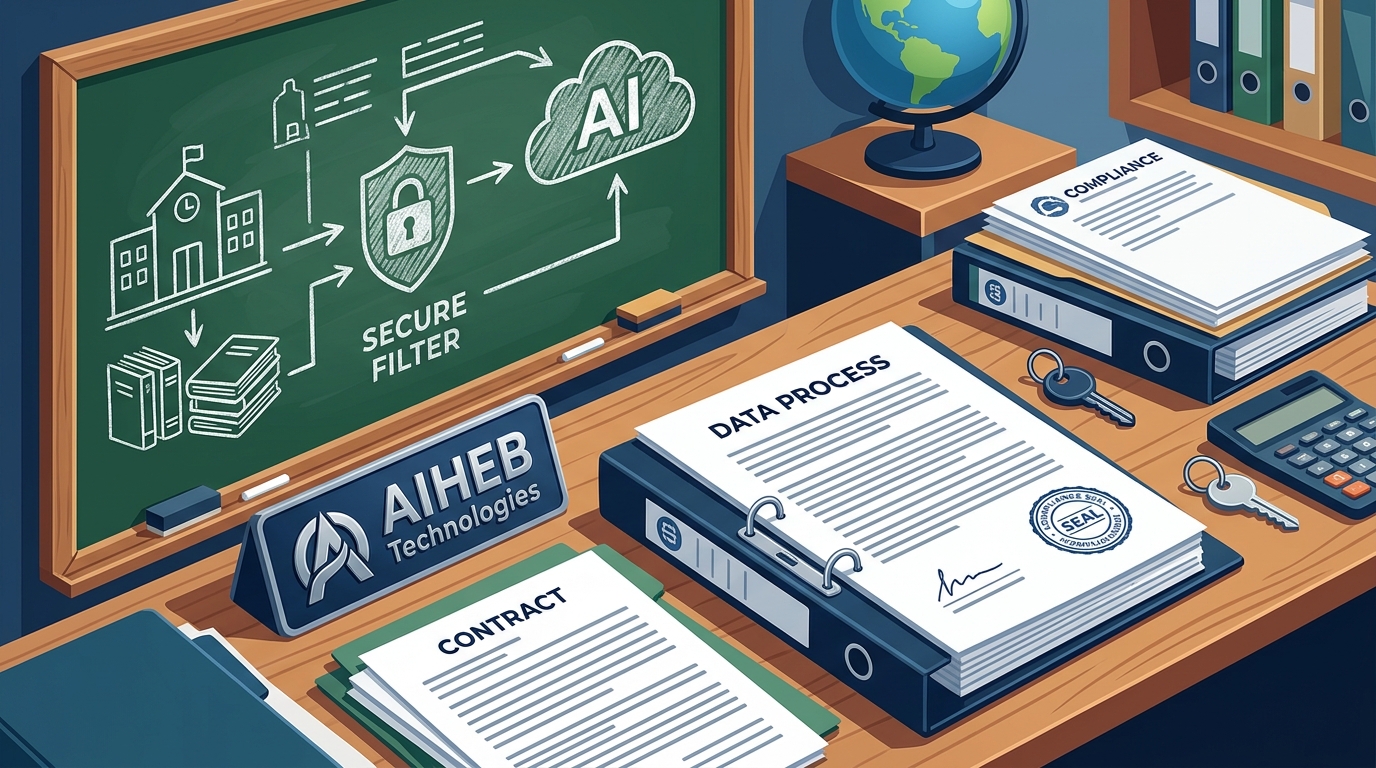
A data processing agreement (DPA) is a legal contract between a data controller and a data processor that defines the terms and conditions under which personal data is processed. In the context of FERPA, the DPA serves as the operational backbone of the school official exception. It translates the legal concept of direct control into specific technical and administrative obligations. The agreement must specify the subject matter, duration, nature, and purpose of the processing, as well as the type of personal data and categories of data subjects. For additional details, review the Frequently Asked Questions.
Essential Clauses for AI Vendors
Sub-processor Management
AI systems often rely on sub-processors, such as cloud hosting providers or specialized model inference services. The DPA must require the primary vendor to obtain prior authorization from the school before engaging any sub-processor. The primary vendor remains fully liable for the actions of its sub-processors. This chain of liability ensures that the school's direct control extends to every entity that touches student data. Schools should request a current list of sub-processors and review their own compliance postures. For additional details, review the About.
Vendor Contracts and Liability
Vendor contracts are the binding legal instruments that enforce FERPA compliance obligations. While the DPA focuses on data processing mechanics, the broader vendor contract addresses liability, indemnification, and audit rights. A robust contract ensures that the school is protected if the vendor experiences a data breach or fails to meet compliance standards. The contract should explicitly state that the vendor is acting as a school official under FERPA and that any breach of this status constitutes a material breach of contract.
Indemnification and Insurance
Audit Rights and Transparency
Data Minimization Strategies
Anonymization and Pseudonymization
Anonymization is the process of irreversibly removing all personally identifiable information from a dataset. Pseudonymization is the process of replacing direct identifiers with artificial keys, allowing data to be re-identified only with additional information. For AI training and testing, schools should use anonymized or pseudonymized data whenever possible. If direct identifiers are necessary, they should be stored separately from the data used for model processing. AIHEB Technologies implements data minimization by design, ensuring that its AI platforms request only the minimum data required for their specific educational functions.
Access Controls and Segmentation
Access controls ensure that only authorized personnel can view or process student data. Data segmentation involves dividing data into distinct categories based on sensitivity and purpose. For example, academic performance data should be segmented from health data or disciplinary records. This prevents unauthorized access and limits the blast radius of a potential breach. Schools should enforce the principle of least privilege, granting users access only to the data they need to perform their specific job functions.
Staff Training and Governance
Role Based Training
Training should be tailored to different roles within the institution. Administrators need to understand vendor management and contract review. Teachers and staff need to understand how to use AI tools safely and what data they should and should not input. IT staff need to understand technical security controls and incident response. Role based training ensures that each group receives the specific knowledge they need to perform their duties in a compliant manner.
Incident Response and Reporting
Key Takeaways
- The school official exception requires vendors to be under the direct control of the school regarding data use.
- Data processing agreements must explicitly prohibit the use of student data for AI model training.
- Data minimization involves collecting only the necessary data and using anonymization or pseudonymization.
- Staff training is critical and should be role based, covering specific AI use cases and incident reporting.
- Schools must retain audit rights to verify vendor compliance and data handling practices.
- Regular review of vendor contracts and data processing agreements is essential as AI technologies evolve.
Frequently Asked Questions
Does FERPA apply to AI tools used by students?
Can a vendor use student data to improve their AI models?
Only if the school explicitly agrees and the vendor is no longer acting as a school official. This requires a separate agreement and may involve additional privacy risks. Most schools should prohibit the use of student data for model training to maintain the school official exception.
What is the difference between a DPA and a vendor contract?
How often should schools review their AI vendor contracts?
Schools should review contracts annually or whenever there is a significant change in the vendor's services or data processing practices. Regular reviews ensure that the contract remains aligned with current legal requirements and the school's compliance goals.
What is data minimization in the context of AI?
Data minimization is the practice of collecting and processing only the data that is strictly necessary for the specific purpose. In AI, this means avoiding the ingestion of unnecessary personal data into models and using anonymization or pseudonymization where possible.
Does AIHEB Technologies use student data to train its AI models?
No, AIHEB Technologies does not use customer data to train its AI models. The company is committed to data privacy and ensures that all data is used solely for the specific educational functions specified by the client. Learn more: 4000ai org.