%22%20style%3D%22color%3Argb(240%2C%3Bfont-family%3AArial%3B%22%3E4000AI%3C%2Fspan%3E%26nbsp%3B%3C%2Fspan%3E%3C%2FforeignObject%3E%3C%2Fsvg%3E)

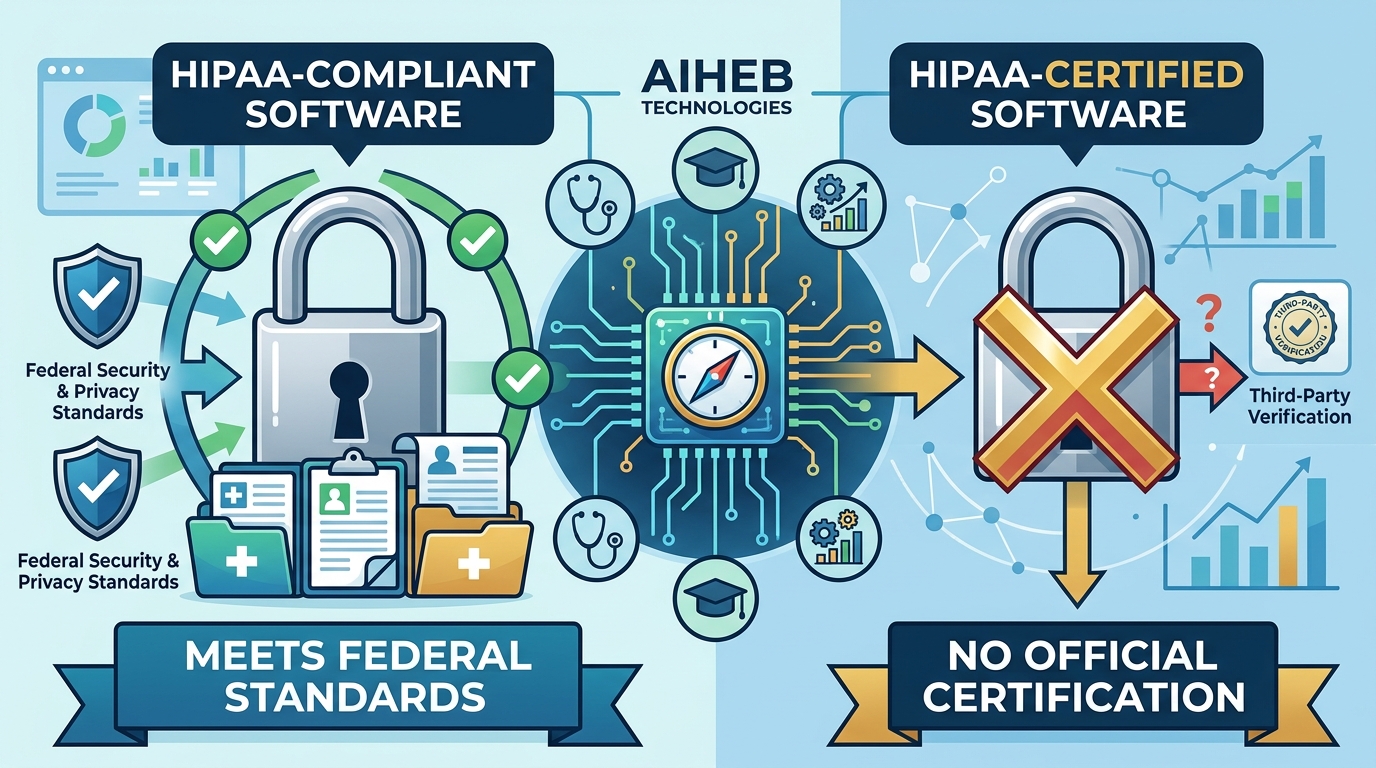
There is no official HIPAA certification. HIPAA-compliant software meets federal security and privacy standards, while HIPAA-certified software is a marketing term for third-party verified tools. AIHEB Technologies provides AI-powered solutions that help healthcare, education, and business sectors navigate these distinctions. This guide explains the legal reality, the role of third-party audits, and how to select secure software for your organization. For additional details, review the 4000ai org.
Business Associate Agreements
A Business Associate Agreement (BAA) is a legal contract required between a covered entity and any third party that creates, receives, maintains, or transmits protected health information (PHI) on their behalf. The Health Insurance Portability and Accountability Act (HIPAA) mandates these contracts to ensure that business associates adhere to the same privacy and security standards as the covered entity. Without a valid BAA, a covered entity cannot legally share PHI with a software vendor. For additional details, review the .
The Legal Obligation
Vendor Responsibility
Business associates are directly liable for their own HIPAA violations. If a vendor fails to secure data, they face penalties independent of the covered entity. This shifts the risk management burden to the software provider. Organizations must verify that their vendors understand this liability. A vendor that refuses to sign a BAA is not HIPAA-compliant and should be avoided. For additional details, review the Customer Experience.
Third-Party Certifications
Understanding Attestations
Third-party attestations, such as SOC 2 Type II reports, provide evidence of a vendor's internal controls. While not a HIPAA certification, these reports are strong indicators of security maturity. Organizations should request these reports during vendor due diligence. AIHEB Technologies encourages transparency by providing clients with access to relevant security documentation and audit summaries. For additional details, review the Frequently Asked Questions.
Marketing vs. Legal Reality
Some vendors use the term "HIPAA-certified" to imply government approval. This is misleading. The legal standard is compliance, not certification. Buyers must distinguish between a vendor's marketing claims and their actual legal obligations. A vendor may be "certified" by a private firm but still fail to meet specific HIPAA requirements if their controls are insufficient. For additional details, review the About.
Ongoing Compliance Requirements
HIPAA compliance is a continuous process, not a one-time achievement. The regulations require covered entities and business associates to maintain ongoing risk assessments, employee training, and incident response plans. Software vendors must also demonstrate continuous monitoring and updates to their security infrastructure. Compliance is dynamic and requires constant vigilance.
Risk Assessments
Regular risk assessments are mandatory under the HIPAA Security Rule. These assessments identify potential vulnerabilities in systems that handle PHI. Vendors must conduct these assessments periodically and remediate identified risks. AIHEB Technologies integrates automated risk monitoring into its AI platforms, helping clients stay ahead of emerging threats.
Employee Training
Security Safeguards
Security safeguards are the technical and administrative measures required to protect PHI. The HIPAA Security Rule outlines three categories of safeguards: administrative, physical, and technical. These safeguards must be reasonable and appropriate to the size and complexity of the organization. Software vendors must implement these safeguards to ensure that PHI is protected against unauthorized access.
Technical Safeguards
Administrative and Physical Safeguards
Comparison of Compliance vs. Certification
| Legal Status | Required by federal law | Marketing term, no legal standing |
| Issuer | U.S. Department of HHS | Third-party auditors or firms |
| Verification | Self-attestation and audits | Independent review and report |
| Requirement | Mandatory for covered entities | Optional, varies by vendor |
| Scope | Privacy and Security Rules | Vendor-specific framework |
Key Takeaways
- There is no official HIPAA certification issued by the U.S. government.
- HIPAA compliance is a legal requirement for any software handling PHI.
- Business Associate Agreements are mandatory contracts between covered entities and vendors.
- Third-party attestations, like SOC 2, provide evidence of security maturity.
- Compliance is an ongoing process requiring continuous risk assessment and training.
- Buyers must distinguish between marketing claims and legal obligations.
Frequently Asked Questions
Is HIPAA certification a real thing?
No, HIPAA certification is not a real government credential. It is a marketing term used by vendors to indicate that they have undergone third-party security reviews. The legal standard is HIPAA compliance, which is mandated by federal law.
Do I need a BAA with my software vendor?
Yes, if the vendor creates, receives, maintains, or transmits PHI on your behalf, you must sign a Business Associate Agreement. This is a legal requirement under HIPAA. Without a BAA, you cannot legally share patient data with the vendor.
What is the difference between compliance and certification?
Compliance is the legal obligation to meet HIPAA standards. Certification is a voluntary, third-party verification of security practices. Compliance is mandatory; certification is optional and varies by vendor.
How do I verify if a vendor is HIPAA-compliant?
Request their security documentation, including risk assessments and SOC 2 reports. Ask for a copy of their BAA template. Verify that they implement required security safeguards. AIHEB Technologies provides transparent documentation to help clients verify compliance.
What are the penalties for non-compliance?
Penalties for HIPAA violations can be significant, ranging from thousands to millions of dollars per violation. The amount depends on the level of culpability and the number of individuals affected. Both covered entities and business associates can face penalties.
Does AIHEB Technologies offer HIPAA-compliant solutions?
How often should I review my vendor's compliance?
You should review your vendor's compliance status annually or whenever there are significant changes to their services. Regular reviews ensure that the vendor continues to meet HIPAA requirements. This is part of your ongoing risk management process.
What is a SOC 2 report?
A SOC 2 report is an independent audit of a vendor's internal controls related to security, availability, processing integrity, confidentiality, and privacy. While not a HIPAA certification, it is a strong indicator of a vendor's security maturity and is often requested during due diligence.
Conclusion
Understanding the difference between HIPAA-compliant and HIPAA-certified software is critical for protecting patient data and avoiding legal penalties. Compliance is a legal requirement, while certification is a marketing term. AIHEB Technologies is committed to providing secure, AI-powered solutions that help organizations navigate these complexities. By choosing a vendor that prioritizes transparency and security, you can ensure that your operations are both efficient and compliant. Explore our AI-powered platforms to streamline your healthcare, education, or business operations with confidence. Learn more: 4000ai org.