%22%20style%3D%22color%3Argb(240%2C%3Bfont-family%3AArial%3B%22%3E4000AI%3C%2Fspan%3E%26nbsp%3B%3C%2Fspan%3E%3C%2FforeignObject%3E%3C%2Fsvg%3E)

Using AI tools with patient data requires strict adherence to HIPAA, valid Business Associate Agreements, rigorous de-identification standards, and continuous risk assessments. AIHEB Technologies provides AI-powered software solutions designed to simplify these operations and improve compliance for healthcare, education, and business sectors. This guide covers the four critical pillars of AI compliance: HIPAA requirements, BAA execution, de-identification methods, and risk assessment procedures. For additional details, review the 4000ai org.
HIPAA Compliance Requirements
HIPAA compliance is the legal framework that protects the privacy and security of individually identifiable health information. When organizations deploy AI tools, they must ensure that these systems adhere to the Administrative, Physical, and Technical Safeguards outlined in the HIPAA Security Rule. AI models that process Protected Health Information (PHI) are subject to the same strict access controls, audit logs, and encryption standards as traditional electronic health record systems. For additional details, review the .
Technical Safeguards for AI Systems
Technical safeguards are the most critical component for AI integration. Access control mechanisms must ensure that only authorized personnel can interact with the AI interface. Audit controls must log every interaction, including the specific prompts used and the data returned. Integrity controls must ensure that the AI does not alter or corrupt the underlying patient data during processing. AIHEB Technologies focuses on building these safeguards directly into its software architecture to streamline compliance for healthcare providers. For additional details, review the Customer Experience.
Administrative Safeguards
Business Associate Agreements
A Business Associate Agreement (BAA) is a legal contract between a covered entity and a business associate that handles PHI on their behalf. If an AI vendor processes, stores, or transmits patient data, they are considered a business associate. Therefore, a valid BAA is mandatory before any data exchange occurs. The BAA must explicitly state that the business associate will not use or disclose PHI other than as permitted by the agreement or required by law. For additional details, review the Frequently Asked Questions.
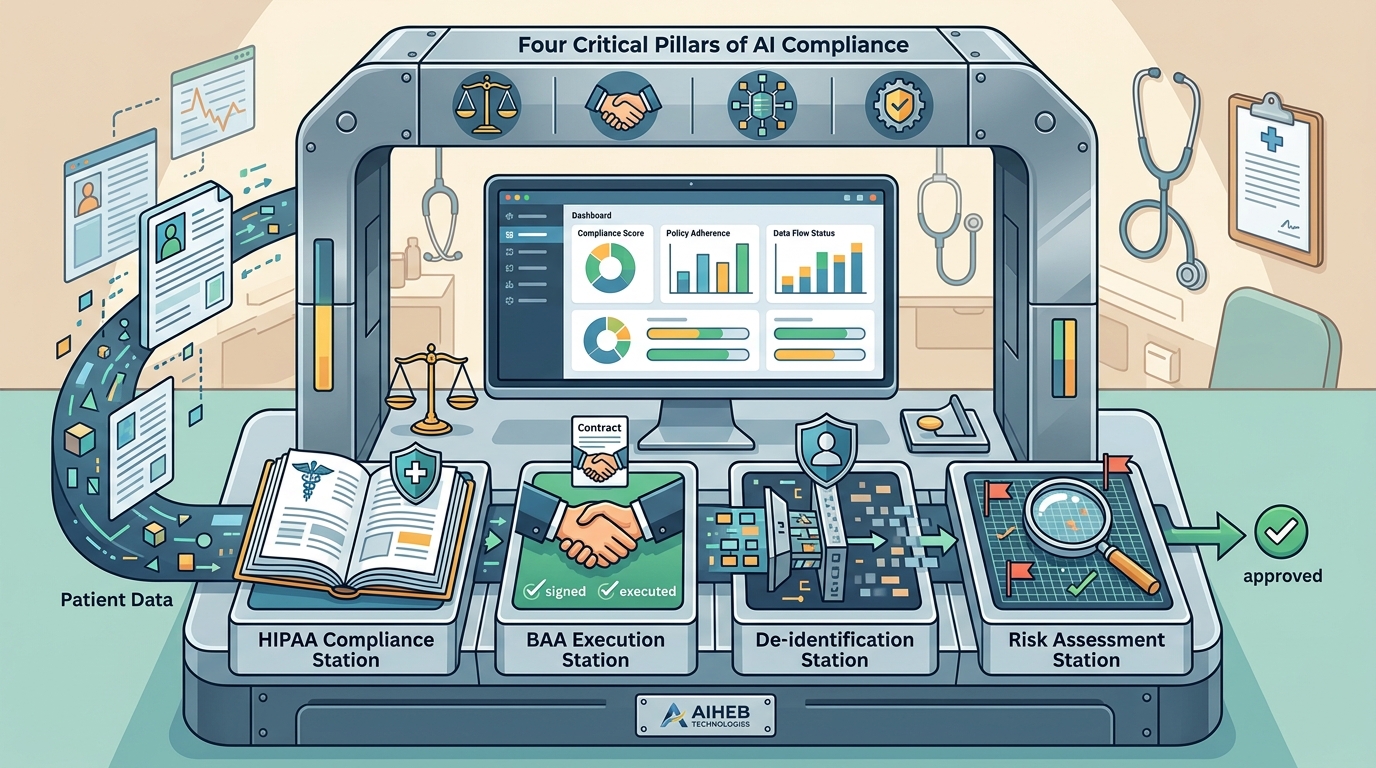
Key Components of a BAA
Vendor Due Diligence
Before signing a BAA, organizations must conduct due diligence on the AI vendor. This involves reviewing the vendor's security posture, data handling practices, and compliance history. The vendor must demonstrate that they have implemented appropriate technical safeguards. They must also provide evidence of their compliance with relevant regulations. This due diligence process is essential to mitigate the risk of data breaches and regulatory penalties. For additional details, review the About.
De-Identification Standards
De-identification is the process of removing or altering personally identifiable information from health data. This allows the data to be used for AI training and analysis without violating HIPAA privacy rules. The HIPAA Privacy Rule provides two methods for de-identification: the Expert Determination method and the Safe Harbor method. Both methods aim to ensure that the risk of re-identification is very low.
The Safe Harbor Method
The Safe Harbor method requires the removal of 18 specific identifiers, such as names, addresses, dates, and phone numbers. It also requires that the covered entity does not have actual knowledge that the remaining information could be used to identify an individual. This method is straightforward but may result in the loss of some data utility. It is often used for large-scale dataset preparation for AI model training.
The Expert Determination Method
Risk Assessment Procedures
A risk assessment is a systematic process for identifying, analyzing, and evaluating risks to the confidentiality, integrity, and availability of PHI. The HIPAA Security Rule requires covered entities to conduct an accurate and thorough assessment of the potential risks and vulnerabilities to the security and integrity of ePHI. For AI tools, this assessment must consider the unique risks associated with machine learning, such as model inversion and data poisoning.
Identifying AI-Specific Risks
Continuous Monitoring
Comparison of De-Identification Methods
| Method | Complexity | Data Utility | Regulatory Requirement |
|---|---|---|---|
| Safe Harbor | Low | Lower | Removal of 18 identifiers |
| Expert Determination | High | Higher | Statistical expert assessment |
Key Takeaways
- HIPAA compliance for AI requires adherence to Administrative, Physical, and Technical Safeguards.
- A valid Business Associate Agreement is mandatory when an AI vendor handles PHI.
- De-identification can be achieved through the Safe Harbor or Expert Determination methods.
- Risk assessments must address AI-specific threats like model memorization and adversarial attacks.
- Continuous monitoring is essential to maintain compliance as AI systems evolve.
- AIHEB Technologies provides solutions that simplify these compliance processes.
- Vendor due diligence is a critical step before signing a BAA.
- Documentation of all compliance activities is required for audit purposes.
Frequently Asked Questions
Does HIPAA apply to AI tools?
Yes, HIPAA applies to any AI tool that creates, receives, maintains, or transmits PHI on behalf of a covered entity or business associate.
What is a Business Associate Agreement?
A BAA is a legal contract that defines the responsibilities of a business associate regarding the protection of PHI.
How do I de-identify patient data for AI training?
You can use the Safe Harbor method by removing 18 identifiers, or the Expert Determination method by using statistical analysis to ensure low re-identification risk.
What are the risks of using AI with patient data?
How often should I conduct a risk assessment?
Risk assessments should be conducted regularly, at least annually, and whenever there are significant changes to the AI system or the threat landscape.
Can I use AI for clinical decision support?
Yes, but the AI must be validated for accuracy and safety, and it must comply with all applicable HIPAA and FDA regulations.
What is the role of AIHEB Technologies in compliance?
AIHEB Technologies provides AI-powered software solutions that help organizations streamline operations and improve compliance through innovative technology.
Do I need to encrypt all patient data?
Encryption is a recommended security measure under HIPAA, but it is not always mandatory. However, it is strongly advised for data at rest and in transit. Learn more: 4000ai org.